The next social media imperative: Defining YOU

Was I clever enough?
Was I charming?
Did I make at least one good pun?
Was I disconcerting? Disarming?
Was I wise? Was I wan? Was I fun?
From “Thoughts While Driving Home” by John Updike
I’m going off the chart a bit. Over the next few days I want to explore your sense of “self” and social media. This is not an easy topic but I want to engage with you to discuss:
How are you different on social media … for better or for worse? How do you show up? What is your “brand?”
Is social media the ultimate equalizer, the greatest democracy, or a funhouse mirror warping our view of society?
From a very intimate, personal standpoint, what does it take to succeed on the social web?
To kick things off, I need to pose a very serious question: Who the hell am I … out here?
In my recent post about the social media “country club,” I made a comment that seemed to resonate with a lot of folks: “In social media, the medium isn’t the message. The messenger is the message.”
The idea of having a “personal brand” becomes enormous when everybody has their own global broadcast channel. That’s what social media is, really. When you pay attention to somebody’s blog or tweets, you’re tuning in to their channel. Welcome to Station M-A-R-K, spinnin’ and grinnin’ from the great State of Tennessee.
What type of station are you? News? Entertainment? Sports? Variety? Or Talk All the Time?
I ask because I don’t know myself. I went out to lunch with a new friend last week and he said he enjoyed following me on Twitter. Why? What’s my “on-air” personality? I truly don’t know. I think I have reasonable self-awareness in real life, but the web is another matter …
Sometimes I’m funny, sometimes I’m serious, sometimes I’m absent. I hide the pain and private stuff. I’m often pre-occupied. How does this sum up?
One Twitter-friend referred to me as a gentleman. It only made me wonder — what brought that on?
If 80% of communication is non-verbal and that is completely eliminated through social media, what’s the impact on perceived personality? Pretty dramatic I would think.
How do people perceive us when they only catch snippets at certain times of the day? Believe me, the people who “tune in” to the groggy morning Mark get a vastly different picture than those who catch the late night jokester.
There seems to be an app for everything so I explored the web for answers. Who am I, Mr. Internet? My Twitter Grader number is 99.8 out of 100. But does that mean I’m likable? Engaging? Cranky? My Twitter Analyzer says my celebrity rating is 72 today … but was 2 last week. Twitterholic, Twitter rank, and Twitalyzer provide rankings relative to all other Twitter users. One said I had a lot of “clout” last week but not this week. Twinfluence says I have a velocity of 20,471 second-order followers a day and high social capital. Huh???
While all of these scores are mildly amusing, it still doesn’t help us see ourselves in a new way: Through the eyes of your social media audience. How do we come across to people who have never met us, spoken to us, touched us, or observed a single facial expression … and probably never will?
I’m not asking you to literally tell me about me. I’m thinking you may also be wondering about how you come across in cyberspace? If personal brand is paramount on social media, how do you really know what your brand is?
18 Comments
Other Links to this Post
RSS feed for comments on this post. TrackBack URI


You’re in marketing for one reason: Grow. 


By Wintress, October 11, 2009 @ 9:04 pm
Hi Mark,
Love the blog, as always. Honestly, I try my hardest to be myself on blogs, and in emails, and on our website, and on forums, and on twitter, and on Facebook, and well..you get the point. There is a reason for this, other than the fact that “I feel most comfortable being myself.” There is also a reason for this, other than “I feel that it’s most honest to be oneself.” (Which is also, how I feel, by the way.)
The reason is that if I want to make a connection online — with other marketers so we can share knowledge, with other businesses so we can form partnerships, with potential clients — like attracts like. That is, honestly, there are a lot of people that are not the right fit for us. I’ve figured that out over 8 years of doing business.
For a long time, my motto was,”If they’ll pay (and it’s not downright illegal), I’ll do it. Thank goodness, we have a base clientele that allows us to be a little more discriminate now! Of course, if you’re starting at the bottom, you can’t be too choosy, but we’ve earned our keep, and in the process, I’ve also learned who we are not good matches with. People who:
1) develop their image before their product or service
2) feel contrived to me
3) are overly salesy — sorry, I know there is probably a place for this, but I usually just can’t go there
To be fair, these people would probably define themselves as (in the same order as above):
1) people who are just as concerned with the end sale, as with the end product
2) people who have spent time constructing their brand persona
3) people whose motto is “If you’re going to be in business, the end result is to make sales. Period.”
So, there you go. That’s my take. I say, be yourself, and you’ll develop lasting relationships. Try to be someone else, and you’re likely to attract the wrong match.
By Wintress, October 11, 2009 @ 9:08 pm
Okay, so I forgot to check “notify me of follow up comments.” So now I have to post something, to check the box. :-)
How’s the WordPress vs. Blogger, by the way?
By Bill Sledzik, October 12, 2009 @ 8:21 am
Enjoyed your thoughts on this topic — as you raise questions I think about every day. Is my online self really authentic, or is it just one of many “roles” I play? Consider that a rhetorical question!
Two of our students (one whose name you’ll recognize) wrestle with these “personal brand” questions from the perspective of new professionals. An interesting first post on a point-counterpoint blog from digital natives.
http://tr.im/Bwza
By Mark, October 12, 2009 @ 9:07 am
Nice reference, Bill. But hard to believe anybody would not self-censor in this day and age!
By Evan Roberts, October 12, 2009 @ 2:22 pm
I think this struggle to define our online brand, or rather to maintain a consistent one, stems from our previously held notions about reputations management. I follow a few people on Twitter who aren’t in PR/Marketing or any kind of business related field, for this exact reason, to see how people who aren’t overly conscious of their “personal brand” use Social media. What I’ve noticed is that they do a lot less apologizing, a whole lot less correcting of statements and they are rarely misunderstood. But their clarity also enables others like them to respond to their tweets more authenticly, and so you see these people with a stream full of @ replies and RTs. Now I know I probably would never be like that, as I meticulously edit/monitor everything I do online, but it is interesting to see what that kind of surity looks like. I like the comparison to the radio. I’m more like a PR/Tech NPR, but I would describe those people as XM in it’s early stages, before it became regulated.
By Mark, October 12, 2009 @ 3:22 pm
Nice analogy, Evan. Thanks for taking the time to comment.
By Bill Sledzik, October 12, 2009 @ 3:34 pm
I’m chuckling at Evan’s comment, coming from a young and insightful Ohio-based professional. Follow @erob1 on Twitter.
Evan’s note reminds me of yet another analogy — those who have tattoos and those who don’t. In PR and most “suit” business, tattoos violate the “brand.” But for GenY, the “no visible ink” rule is breaking down fast.
Same thing on Facebook and Twitter. The facades are eroding, and with it goes part of the corporate mold.
Not sure PR people will ever fully benefit from these changing norms. We tend to be those who have tattoos, but in places no one ever sees until we’re naked. And PR people tend to never get naked with the lights on. We don’t like to reveal too much.
I think the analogy just got away from me. So sorry :-)
By Evan Roberts, October 12, 2009 @ 3:50 pm
Thanks for the follow Monday Bill!
And as a tattoo/piercing free GenYer, I have to agree with your analogy.
It seems like a bit of a “do as I say, not as I do” thing with us PR folk online. We tell the CEOs we work for to “be authentic” in their online dealings and then we’re guarded and almost cryptic in our own. I’ve met several people whom I thought to be fairly conservative online, who turned out to be a lot different (read nuts) in person. I know people have probably noticed the same about me, and I’m OK with that. As PR pros have typically had a much more background role, the fact that SM brings us into the spotlight is something we’ll all need to adjust to.
And I’d probably never use the word “naked” in a comment either, except for just then. But then, this is a “safe space”
By Mark, October 12, 2009 @ 4:38 pm
@Bill and @Evan
Two thoughts:
1) “authentic” may have a different meaning in a business setting. Perhaps we really mean “consistent.” Act online as you act in business … which is probably stiff and guarded … cover the tattoos … it’s what people expect.
2) So if everyone is “consistent,” those who are truly authentic, like Richard Branson, have an opportunity to significantly differentiate themselves through their personality. Something to consider.
In some ways, this works for me. My “voice” on my blog has been described as “raw.” I tend to be pretty transparent and irreverant. In the past few weeks I have successfully worked the hat-trick of “turd” “dipshit” and “booger” into my blog. A crowning achievement.
By contrast, this might not work for Bill since he is a university faculty member and his blog is an extension of his work. I have my own business and I’m just an adjunct. Nobody seems to give a damn. : )
But I do think this is a reason some people are drawn to my blog. I read many of the top bloggers. They say they’re not P.C., but they are, especially if they work for a company. It’s all VERY “consistent!” A risk and an opportunity for all young people getting into social media. And if you’re getting into business, you’re getting into social media.
By Bill Sledzik, October 12, 2009 @ 5:37 pm
First to Evan. The “naked” thing wasn’t my idea. Blame that on Scoble & Israel: http://tr.im/BzJ7 I do value your perspective, because I see it reflected in an entire generation.
Mark, what I’m hearing from GenY is they’re a bit fed up with “consistent.” Not saying I agree with the attitude — but I am seeing a lot more tattoos in visible places these days. Maybe there’s a correlation!
On the other hand, my generation had long hair, peace signs and free love. Eventually, we conformed and became “consistent.” It happens when you get a mortgage and a couple of kids.
As to your blog voice, I think you’re dead on. I’m drawn to this site because I see a writer who speaks his mind and doesn’t worry about being admitted to the “club.” That’s authentic.
If I appear more guarded in my writing, I assure you it has nothing to do with my university affiliation. One benefit of tenure. One of these days I’ll work up the nerve to call someone a dipshit. And I know it’ll feel great!
By Jamie Lee Wallace, October 12, 2009 @ 5:41 pm
Hello, Mark. I’ve missed you! Embarrassed to say that I only just flipped the switch on your blog transition … I’ve been catching up on the past few weeks.
Love the ideas stirred up by this post. So much of social media’s ultimate impact lives outside the realm of “pure business.” The question you pose dives right into the messy midst of this gray area where our professional and personal lives, personalities, and agendas mix together in the often murky waters of social media relationships.
I’m in the same boat as you: a work-in-progress, unclear about which “personal brand” I represent. As a “solopreneur,” I find myself waffling over foundational decisions like whether I should have a single twitter ID or one that’s my name and one that’s my business name. I also work in several sectors (B2B, parenting, non-profit,social media, etc) – should I have a different identity for each one?
The thought of managing all those accounts makes me queasy. And it also feels inauthentic to me. Do I really need to present a different face to each audience, or can I merge my interests and skills into a single, multi-faceted personality? Is personal brand based more on the content, or the presenation of that content? In venues like twitter, do followers want single-track information feeds, or three-dimensional relationships that cross over from one area to another?
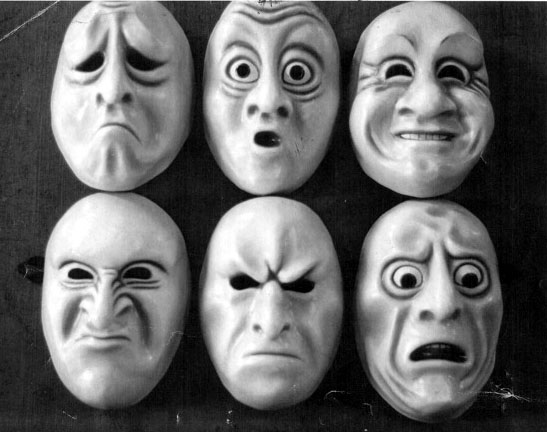
In a perfect world, each of us would do work we love … the way we like to do it with the people we enjoy. We wouldn’t have to hide any facet of who we are (except the seriously TMI stuff). We would be operating more as “full” human beings instead of the masks (as your image so beautifully conveys) for each of our personal and professional roles.
Wouldn’t that be nice?
SO, how do you define (or discover) your personal brand? Since I’m still floundering, I’m not the best person to answer, BUT …
You pay attention to what you put out there – not to judge or edit, but just to observe yourself – your patterns, habits, routines. You pay attention to what others say about you – directly, in blog comments, via RTs, etc. You try to correlate what you think you’re projecting against what people notice most about you. Somewhere in the intersection of those two, is the seed of your personal brand.
By Steve Dodd, October 12, 2009 @ 5:52 pm
Hey Mark, as always you come up with such interesting topics. In a prior post you got us all discussing “who owns your brand” and I think this is somewhat relevant here as well. Personally, I’m not smart enough to create a personal”Brand” per se (and am not sure I want to “create” one anyway). I just am who I am, post what I find interesting or about things I’m particularly passionate about (ie: security, privacy, ROI etc.) and comment accordingly. Some like it, some don’t. But, I have a decent following and follow a decent number of folks. My intent is to provide value, insite discussion and most importantly, learn. I believe my “Brand” is whatever my “followers” (I really hate that term, sounds so cult-like) believe it to be. Past that, I have no clue other than to know that I’ve met some fantastic people (personally) who share my interests through this activity that I’d never have met otherwise. And, BTW, some of turned into terrific business opportunities (because we do share common ideas and interests).
Perhaps, people are worrying too much about “creating” a brand and not enough time “becoming” one. “Create” has such false connotation to me, especially when discussing personal relationships.
By Mark, October 12, 2009 @ 7:14 pm
@Bill — I look forward to your dipshit day. We will toast each other.
@jamie — I am SO GLAD you’re back! I actually referenced your “bartender” piece in a blog comment on ROI today!
I like your wisdom. My problem is I tend to focus on the negative more than the positive when assessing feedback. When somebody says something nice, I tend to say “yeah, yeah …” Plus, I think people are probably overly nice on SM.
@Steve I agree that some people intentially create brands and personas. I am fighting over that with a client right now who has actually created a script for their online “character!” But I haven’t created one for myself. I pretty much am who I am, but it is difficult to know how I come across to people. Who only catch glimpses here and there. Yet, it is so vitally important to social media success! Such an interesting topic.
By Steve Dodd, October 12, 2009 @ 8:11 pm
Jamie has made a terrific point. Your brand is an intersection of a number of things. You, as an example, create more blog discussion (not just quickie comments) than most. I’ve no idea how many read it but you certainly get some powerful opinions from some very intelligent folks. To me, that is the begining of your brand and really talks to what people think about you.
You said you focus on the negative and tend to regard the positive as somewhat of a “false” niceness. Well, I’ve been selling for years and one of the key things sales people do is figure out who’s the most likely to buy what you have. Many companies focus on “Losses” and endlessly try to fix what’s “broken”. Those really successful tend to focus on “Wins” and just try to find out who else is out there like them to sell to. Of course “Loss” analysis can provide tremendous information about competition, required product features etc., but nobody can be all things to all people.
I think this is especially true in this new Social Media domain. It gives us the ability to find like minds and learn from others. Don’t downplay the positive things people are saying and perhaps you want to find more of the same.
Perhaps we need to firstly define the term “Social Media Success” and then look at this topic from that perspective? Since “Success” will mean different things to different people, so will the answer to your initial question.
By Bill Sledzik, October 12, 2009 @ 8:46 pm
Can’t resist this thread. An intriguing topic. Well, at least 5 of us think so!
Folks who know me will tell you my blog and my tweets are pretty much who I am. I take my work seriously, but my social media a little less so. I’m a tad outspoken and an incurable smartass. I like to make people laugh.
But one day someone ask me: What’s up with the hooded avatar? My response: I like being just a little scary. It’s part of the schtick.
So to some degree, I have to admit to orchestrating the persona. I think we all do it – consciously or otherwise. And much of it is likely ego-driven.
By Jamie Lee Wallace, October 12, 2009 @ 8:50 pm
@Mark – Guilty of the same. It’s human nature to notice our warts more than our lopsided halos. ;) It’s a nice practice, however, to take conscious note of the good stuff. Just don’t get your halo on too straight – we like you lopsided!!
By Jamie Lee Wallace, October 12, 2009 @ 9:37 pm
@Steve – Love your addition of contrasting and comparing the value of wins and losses. I think it’s also critical to, as you put it, “define the term “Social Media Success.” If we don’t know what we’re after, how can we plot a course that will allow us to accomplish that desired success?
More for me to think on – thanks for the added layers. :)
By Jim LeBlanc, October 12, 2009 @ 10:44 pm
Just catching up with the blog, too Mark. This really made me think. I just think there is no way to adequately express myself through the web in a way that really reflects who I am. It’s like knowing an author only by reading their book. I think the point about body language is key. Not just expressions, but the fact that even the people I have come to know well on the web will never sit with me and have a meal or drink, never get a hug, never see me with my children, never hear my laugh. Can you really know people on here? It is what it is, but like you, I’m not sure I will ever really know what I seem like to you out there in cyberspace. For me, this was a very powerful reflection. Thanks!