


 You’re in marketing for one reason: Grow. Grow your company, reputation, customers, impact, profits. Grow yourself. This is a community that will help. It will stretch your mind, connect you to fascinating people, and provide some fun along the way. I am so glad you’re here. -Mark Schaefer
Before I was a public speaker, I was a teacher.
So, when I was invited to give public speeches for the first time, I naturally assumed this was just another type of teaching — fill the audience with as much knowledge as possible in the allotted time. My instinct was to cram 30 years of marketing into 45 minutes, as if knowledge were a carry-on and I could just sit on the suitcase until it closed.
Luckily, early in my career I received some advice that saved me.
I listened to a podcast featuring a professional speaking coach, and he emphasized that the biggest mistake speakers make is teaching instead of entertaining. I owe my entire speaking career to a man whose name I have forgotten. Sir, if you’re reading this, you were right, and I’m sorry.
Yes, your audience wants to learn something, but to be effective, those people sitting in the dark room after lunch also need to have some fun. In fact, that is a critical part of the learning.
He offered this format which I continue to teach to my students today.
- 30 minute speech = Three main takeaways
- 45 minute speech = Four takeaways
- 60 minute speech = Five takeaways
… and all of these takeaways are reinforced with entertaining personal stories and data/research where needed.
 He made the critical point that a successful keynote speaker is an entertainer, with every story and body movement carefully orchestrated.
This perspective overhauled my view of a speaking career. If I wanted people to pay me, I had to have an element of entertainment, and I had to learn how to do that.
Often, people come up to me and recall a speech they saw many years ago. I’ve never had one person tell me, “That was the best bar chart ever!” But they remember the impactful stories, the humor, the way I played with the audience. That is how people learn and then tell others what they’ve learned.
How to be entertaining
I recently attended a marketing conference and sat in the audience for three hours before I heard somebody in the audience laugh. It felt like a long nap with a coffee break.
It’s not that the presentations were incredibly serious or that the audience was disinterested. The problem was that the speakers were dutifully sharing information, and that does not make for a great or memorable speech.
Here are a few little tips to spice up your next talk:
HUMOR
There’s money in the funny. Don’t force jokes. But tell a story that would make your friends laugh.
Pro tip: This is one place ChatGPT seems to strike out. It just cannot be funny in context. You’ve got to make it your own and relevant to the audience.
VULNERABILITY
Every great speaker has an opening line that brings the audience in. Last week my line was, “I want to share with you the most inspiring moment of my career. And it was also the most humbling.” I wasn’t oversharing. I was just telling the truth about the moment. This is a tricky dance. If the audience suspects vulnerability as a cheap performance, you’re dead in the water. Connect through something real and true and, above all, relevant.
SELF DEPRECATION
This is different from vulnerability. Self-deprecation is “I’m an idiot and here’s the proof.” This gives the audience permission to relax. If the expert at the front will laugh at herself, the room exhales.
OPEN LOOPS
“I’ll tell you the worst thing a client ever said to me — but first I need to set it up.” Now they can’t leave. You’ve made a promise the brain wants closed. Plant two or three of these and the attention takes care of itself.
DOUBLE DOWN ON THE VISUALS
In the AI Era, there is no excuse for boring slides or slides you can’t read.
Slides are a great way to show an unexpected, funny, or startling image. If you’re not naturally funny, think about leveraging your visuals.
SHAKE IT UP WITH A VIDEO OR SOUND
It’s so easy to embed a video or sound in a slide. A 60-second video that helps you tell a story shakes up the visual flow and demands the audience’s attention. How many speakers do this? Almost none.
INSIGHTS OVER INFORMATION
If you’re teaching about anything the audience can find through a Google search, you need to reach deeper. Insights, not information, will hold their attention and make them take notes.
BLOCK YOUR ACTIONS
When you’re giving a speech, you don’t want to pace around the stage (a sign of nerves) but being intentional about how you stand, where you stand, and how you use your hands can help tell a story.
I once saw Ann Handley crawl on the stage to emphasize a point and make the audience laugh.
When it’s too much
One of the mistakes I see people make is trying too hard to entertain and connect with an audience.
I’m always suspicious when a speaker asks you to stand up. At that point I know they are going to ask me to dance or yell or something silly like “I like me the way I am!” You’re immediately pissing off the 50 percent of the audience who are introverts.
Nothing bonds a room of strangers faster than the shared dread of being told to high-five a neighbor.
Another warning sign is when people bring their hobbies to the stage like magic, juggling, or playing an instrument. If your keynote requires a ukulele, perhaps you’re in the wrong career.
I’m not saying it’s out of the question … but ask yourself: “Is this more for my benefit, or the success of the people in the audience?”
If you have an important, relevant message backed by memorable stories, you don’t need any schtick.
One last idea
No matter how great the speaker, people zone out about every six minutes and wonder if their dog is sick or what they want for dinner. That is just human nature.
Having a strategy and being intentional about entertainment value doesn’t just make it more fun, it also helps land the points you’re trying to teach.
Common feedback after one of my talks is: “You kept my attention the whole time. How did you do that?” That’s extremely hard to do! And you’ll never achieve that if you’re just dumping data on them.
This is not easy stuff. It has taken me years of practice, observation, and experimentation to get it down. When I started my career, I was a bag of nerves. My first keynote talk, I prepared three takeaways, forty slides, and one change of underwear.
But over time I found my groove. It takes time, customer focus, exhaustive preparation, rehearsal, and a clear intent about your entertainment strategy.
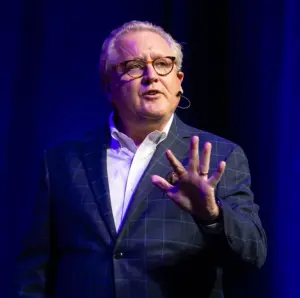 Need a keynote speaker? Mark Schaefer is the most trusted voice in marketing. Your conference guests will buzz about his insights long after your event! Mark is the author of some of the world’s bestselling marketing books, a college educator, and an advisor to many of the world’s largest brands. Contact Mark to have him bring a fun, meaningful, and memorable presentation to your company event or conference.
Follow Mark on Twitter, LinkedIn, YouTube, and Instagram
Illustration courtesy Google Gemini.