Over the past few weeks, I’ve been the fly in the LinkedIn ointment.
You’ve probably seen the bold projections from AI leaders like Mustafa Suleyman and Matt Shumer predicting cataclysmic AI impacts on our work, employment, and artistic endeavors.
There’s a defensive argument surfacing on LinkedIn: “If you care about artistry, you must resist AI.” Many marketers and creators hold on to a hope that the AI Era will have a place for the slow, the steady, the artisanally-crafted tradition of human content. I’ve responded with comments of “probably not.” Which has not been a popular view.
In a webinar last week, I explained how I was using AI as an editor and video producer to make my content exponentially better, faster, and cheaper. I was brutally scalded by one of the webinar participants. “How can you turn video editing over to AI?” one man bristled. “That’s where the craftsmanship happens. That is the artistry. Why aren’t you fighting against AI?”
Good question. Is it time to battle AI and protect human artistry?
I am not anti-human or anti-artistry. But this storyline seems familiar. Before we put on the AI armor, let’s face the music:
A familiar tune
In 1982, the British Musicians’ Union made a remarkable move. They called an emergency meeting and voted to ban music synthesizers from the U.K.
The trigger was Barry Manilow, of all people. On his U.K. tour, Barry had replaced his orchestra with synthesizers. String musicians, horn players, and percussionists lost their work. Traditional artists were furious and responded the way humans almost always do to disruptive change: they tried to make it illegal.
And it was futile.
 The following year, the MIDI software standard was codified, and digital music synthesizers became widely available. Overnight, a person sitting alone in a room could produce music that previously required a full band and technical team.
Within a year of the MIDI revolution, thousands of studio musicians and technicians working on commercials, TV shows, and movies lost their jobs. The market for musicians collapsed.
By the mid-1980s, electronic music had created entirely new industries, careers, and genres. Survival in the music business meant adopting, adapting, and embracing the new technology.
Do we still have musicians? Of course. Do we still have orchestras? Absolutely. But the industry that once supported competent session workers evaporated and never came back.
The number of songs produced each year has exploded. The number of people making a living as full-time musicians has not.
The argument against AI today is exactly the same one made in 1982 against digital music. And the result will be the same.
We need to get ready, and I have an idea about that.
But first, let’s look ahead to our probable future. What do we know to be true? Can we think through the implications? How real is the threat?
What we know to be true:
1. The economic value of intelligence is near zero
Since the beginning of time, humans have prospered and advanced by acquiring knowledge. Every institution is built on the organization of scarce human intelligence. Universities exist because they have been the gatekeepers of knowledge.
These dynamics are irrelevant today because we can’t out-smart AI.
Even the most complex code is being written by bots. AI is developing PhD-level research studies and solving problems in physics and genetics that have stumped humans. Will it be able to create intelligent marketing strategies and insightful content? Of course.
If your career is based on intelligence, you’re vulnerable. Intelligence is abundant and nearly free.
2. Skills don’t matter so much
A primary argument for the worth of humans is that we’ve spent years developing our talents. Surely AI cannot match the experience we’ve honed over decades?
If you believe that AI can’t write as well as you, for example, consider this quote from Mike Kaput, a long-time PR pro and co-host of the (excellent) Artificial Intelligence podcast:
“I’ve been a professional writer for a very long time. I would argue that I’m just shy of being a world-class writer. It is my superpower. And I don’t mean to be arrogant about it, but I have some receipts to prove it.
“By the end of 2025, my use of AI as a writing companion has become very, very different. I can safely say that AI is a better writer than me in every way that counts. That doesn’t mean writing and writers are obsolete. It just means that when it comes to taking my ideas and putting them into really good words, putting them into logical and emotive constructions, AI is just as good as I am — and it’s way faster. It will be even better soon.
“Three years ago, you could see this day coming. It’s not coming, it is here.”
The same thing is happening in video and every other creative field. Responding to a realistic clip of Brad Pitt and Tom Cruise engaging in hand-to-hand combat, Deadpool screenwriter Rhett Reese lamented on X that “I hate to say it, but it’s likely over for us.”
My critic in the webinar said, “Editing work must remain human because that’s where the artistry lives.” The musicians said this in 1982. The monastic scribes said it about the printing press. The darkroom operators said it when digital cameras arrived.
Each time, the argument was emotionally true and economically irrelevant.
The art survived. The skilled infrastructure around the making of art did not.
3. The economics favor the bots
In my book How AI Changes Your Customers, I describe AI’s biggest lie.
Every AI company creates PR spin about how AI will “enable” humans. While this is somewhat true, for these companies to recover the trillions being spent on data centers, research, and energy, they must replace human jobs on a massive scale.
Mustafa Suleyman, the CEO of Microsoft AI and one of the most trusted voices in the field, recently said that most white-collar work will be fully automated within 12 to 18 months. Lawyers. Accountants. Project managers. Marketing teams. Anyone, as he put it, “sitting down at a computer.”
I am humble enough to accept that these insiders see a technological future that I can’t access. Is massive job loss certain? No. But I’m paying attention to these leaders.
Thinking it through
Let’s think through the implications of these realities:
- The economic value of intelligence is near zero
- AI creative skills will meet or exceed human output
- ROI for AI investment requires massive job replacement
I am not an alarmist. I am not a pessimist. I try to see the world as it is, not what I would wish for. But I think there is a probability that my fellow creatives and I are facing a “MIDI moment.”
What can we learn from the musicians who survived that cataclysmic crash?
1. Resistance is futile
The musicians who thrived after 1983 were not railing against synthesizers.
They adapted to the new tools, found the intersection between technology and human creativity, and built careers doing the work that a machine fundamentally cannot replicate.
Adopt AI, don’t fight it. Use it, master it, twist it into exciting new opportunities.
Get over the depression and shock of the AI event horizon and figure out how it can make you bigger, bolder, more creative, and more impactful in this world.
I believe the future still belongs to extraordinary human creativity. But I also believe it is irresponsible to tell young creatives that the economics of the past might protect them. Technology adoption does not honor tradition and artistry. It follows cost curves.
When something becomes:
- 90x cheaper
- 90x faster
- 90% as good
… It wins.
That is not cruelty. That is capitalism.
Acknowledging that reality is not anti-artist.
2. Become a true artist
The MIDI moment separated the great from the competent. Here’s where I need to be concrete, because the conversation tends to get muddled.
I am NOT arguing that AI will replace the editor whose instincts transform raw footage into something that makes you cry. The visionary creative director who tells a story the world needs to hear isn’t vulnerable. The beloved YouTuber or podcaster who creates compelling, entertaining content every day is safe.
I am addressing the layer of technically demanding, repetitive, formulaic work that makes up the majority of billable hours in creative businesses.
If your value is defined by:
- Repetitive technical execution
- Tool mastery alone
- Process efficiency
- Pattern recognition
You’re standing in automation’s path.
If your value is defined by:
- Taste
- Judgment
- Emotional intelligence
- Cultural fluency
- Emotional connection to an audience
- Unmatched talent
You’ll probably become more valuable, not less.
In my book Audacious: How Humans Win in an AI Marketing World, I explore this in depth. If you’re among those who refuse to be ignored, read this book.
If AI content is indistinguishable from human work, nobody cares. Your job is to transcend AI and MAKE. THEM. CARE.
Your blog, podcast, or video series must rise above common, competent AI slop and approach the level of art (more on that here.)
Art will persist. Many jobs won’t. Both things are true.
3. Become known
So here we are. We’ve embraced the technology. We’re expressing our human experience and rising above the slop. That’s not enough. You could be great and still buried in this noisy world.
It doesn’t help to be a star if nobody knows you are a star. You must work on your personal brand.
You don’t have to become famous by dancing on TikTok. But you must have the authority, presence, and reputation to break through the AI pandemic of dull.
Your personal brand is your only long-term defense against AI.
A final word
Many people point to past technological innovations, like the internet or the industrial revolution, to dismiss gloomy forecasts of job loss. They say that over time, technology creates MORE jobs and opportunities.
Sometimes that is true. And honestly, the jury is still out on AI adoption.
But this feels different. In the past six months, I’ve had three relatives lose their jobs to AI. Their entire departments were permanently wiped out by AI.
If you’re replaced by AI, what new job could you create in your field that won’t also be replaced by AI?
And I’m worried about the gap between the tech elites and the vast majority of people who have no idea what AI can really do and what is coming.
Economist Dr. Noah Smith wrote:
If it helps you feel unique and special to sit there and tell yourself, “AI can’t think!”, then go ahead. And sure, AI doesn’t think exactly the way you do. It probably never will, in the same sense that a submarine will never paddle its fins and an airplane will never flap its wings. But a submarine can go faster than any fish, and an airplane can fly higher and faster than any bird, so it doesn’t matter. You can value your own unique human way of thinking all you like — and I agree, it’s pretty special and cool — but that doesn’t make it more effective than AI.
To my passionate LinkedIn pals who want to stay in the slow lane and battle AI, I understand the emotion. I’ve built my career on creativity. I celebrate it. I teach it. I depend on it. I love it.
But believing in artistry does not require denying economic gravity.
And economic gravity always wins.
My friends, we should not “battle AI.”
We should battle mediocrity. Rise above the noise.
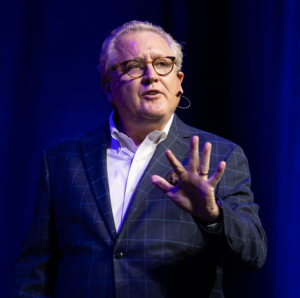 Need an inspiring keynote speaker? Mark Schaefer is the most trusted voice in marketing. Your conference guests will buzz about his insights long after your event! Mark is the author of some of the world’s bestselling marketing books, a college educator, and an advisor to many of the world’s largest brands. Contact Mark to have him bring a fun, meaningful, and memorable presentation to your company event or conference.
Follow Mark on Twitter, LinkedIn, YouTube, and Instagram
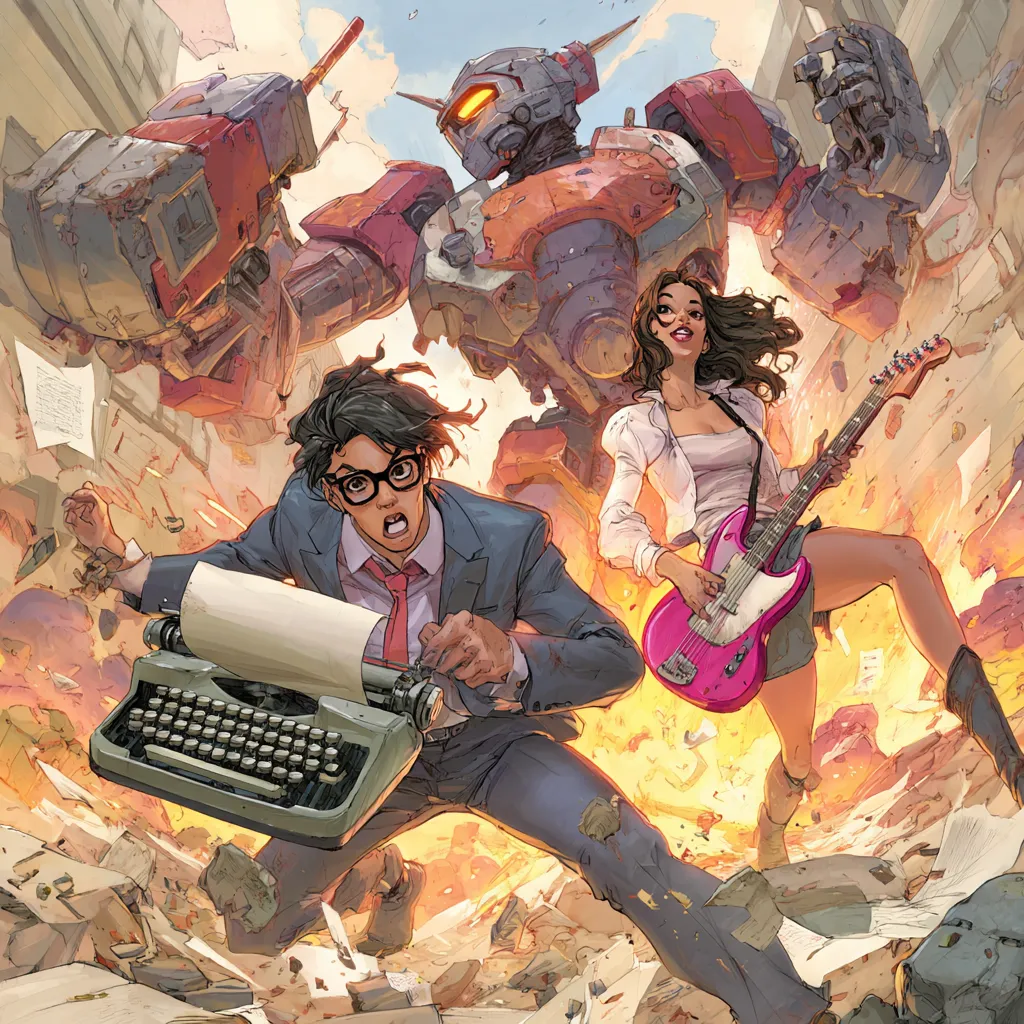
Illustration courtesy MidJourney