


 You’re in marketing for one reason: Grow. Grow your company, reputation, customers, impact, profits. Grow yourself. This is a community that will help. It will stretch your mind, connect you to fascinating people, and provide some fun along the way. I am so glad you’re here. -Mark Schaefer
For years I have been fighting mildew.
I know that’s a weird way to start a blog post, but stick with me. It’s gonna get spicy.
Anyway. My boat. The white vinyl has these little black dots of mildew that have plagued me for years. I’ve tried everything to get rid of it … probably bought 6-7 different solutions that never worked over the last 10 years.
On a whim, I took a photo of the mildew and submitted it to AI. It returned a suggestion I had never heard of before. It wasn’t cheap — $34 for the cleaner. But I took that advice without questioning it, and the darn thing worked like magic.
Since I never stop thinking about marketing, the mildew incident triggered a little alarm in my brain. I’ve never spent $34 on a cleaning product in my life. Seems like a lot. I had outsourced “consideration,” a key marketing idea where I am supposed to do research and consider alternatives when I don’t have a brand preference.
As marketers, we’re always fighting for that consideration, the messy part of the sales funnel where a person weighs options, compares, hesitates, and gets nudged by ads and the sweet memory of our brand name. Consideration is our home office, the phase of the customer journey where we obsess.
I had jumped the gun, and so do a lot of other people …
10 blue links become one answer
I was invited to speak at AdWeek this year and had just researched this very topic — the collapse of consideration — for my speech.
For 25 years, the internet has made consideration easy. You typed a question, Google handed you 10 blue links, and you did the work — clicking, comparing, forming a view.
New research shows this is fading away.
1. One answer for the win
Google’s AI Overviews (knowledge boxes) now appear on roughly half of all searches, and click-through to the actual websites falls by about 60% when they show up. Like my mildew adventure, the answer arrives before I ever leave the page.
If your brand is named in that answer, you earn more than double the clicks of the brands that aren’t. One AI answer appears, and everyone else is invisible.
The consideration set didn’t just shrink. It got body slammed.
2. Top brands may not be on top
Another fascinating development — the traditional brands with the most market share are not necessarily winning the AI answer game.
Princeton researchers found you can lift a brand’s visibility in AI answers by around 40% — not by spending more, but by being more legible to the model. And the biggest gains went to the smaller players, the little startups and disruptors telling a better story to the machines.
AI doesn’t reward the best-marketed brand. It rewards the best-explained one.
3. AI: The new word of mouth?
A new SAP study shows that almost a quarter of respondents said they are more likely to follow AI recommendations than advice from friends and family, signaling shifting influences in retail. Word of mouth has long been a key influence shaping purchasing decisions but AI tools are now providing a similar role with product rankings and tailored suggestions, filtered for individual consumers.
4. People don’t want to think
One last piece of research from my speech: Acxiom found that 73% of consumers said the best brand experience is one that requires minimum effort — just give us the answer. At the same time, 74% of brands worried that a completely frictionless experience becomes forgettable, less distinctive.
Now the spicy part
To add a little zing to this post, I thought it would be fun to test this trend and ask my LinkedIn friends about the most expensive purchase they ever made from a single AI suggestion. Some good ones: a coffee maker. A podcast mic. Two $4,000 computers.
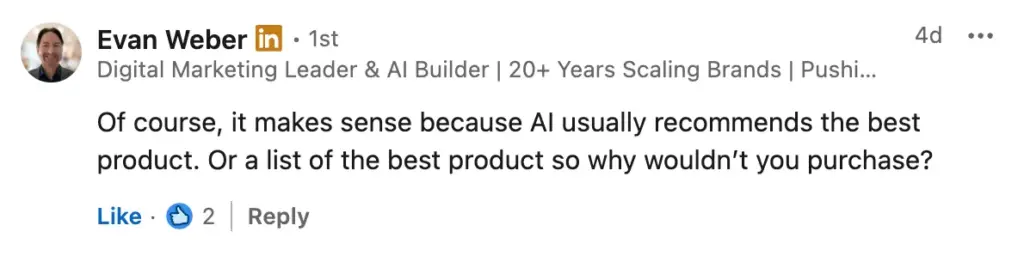
But here was the more interesting part. The pushback.
About 50% of the LinkedIn respondents said they would never buy from an AI recommendation. In fact, some of them attacked me for even considering it.
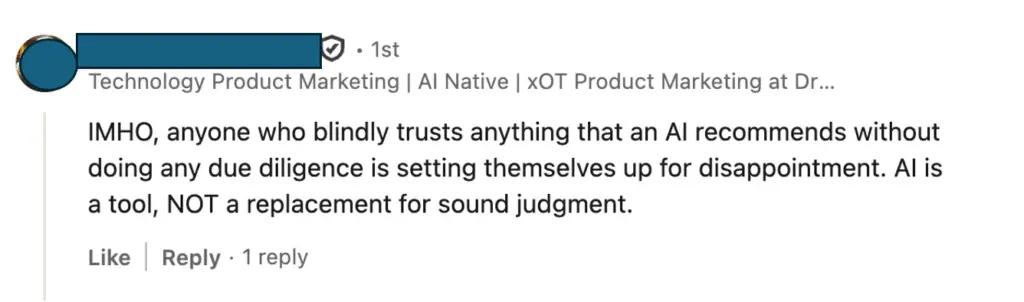
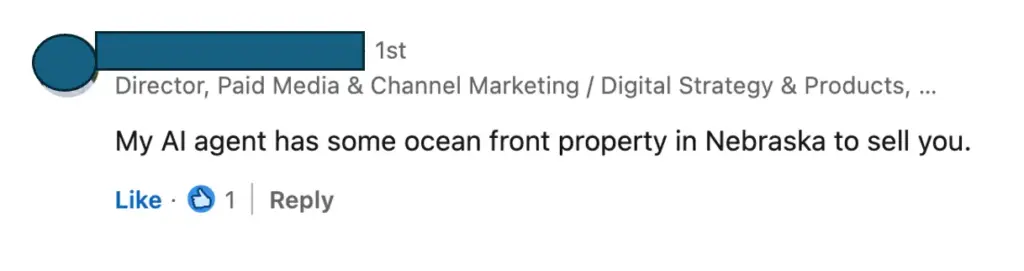
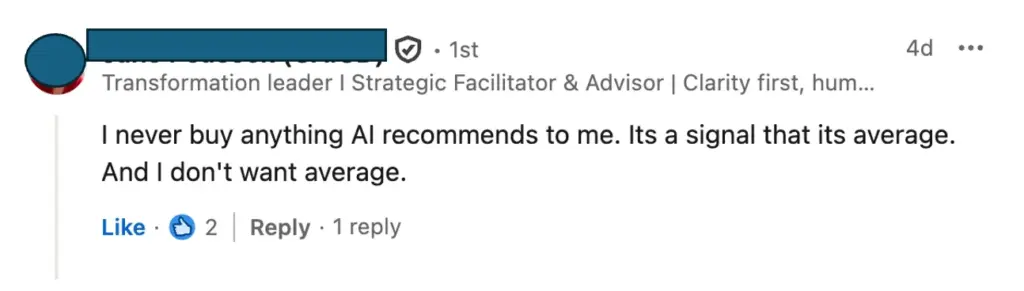
I understand anybody who has anxiety about AI. I do, too. There is certainly a lot to worry about.
But dismissing the possibility of consumers turning decisions over to AI ignores the reality illustrated by the research I just presented.
This backlash was surprising.
I mean, even if you’re searching Amazon, listening to Spotify, or using Google Maps, you’ve abdicated decisions to AI. And the AI answers aren’t just average. Often, they’re the best. Just ask my mildew.
We built an entire marketing infrastructure — ads, funnels, email nurture sequences, retargeting — on one assumption: that people pause in the middle, and in that pause, they can be reached, and maybe even convinced.
When the machine removes the pause, part of our marketing playbook has been shut down.
Bring on the diapers
In my book, How AI Changes Your Customers, I suggest that with the collapse of consideration, we’re all in the diaper business now.
My one-year-old grandson is an excellent pooper. He goes through a lot of diapers. But to sell the end-user diapers, we must appeal to the real decision-makers: mom and dad.
As our customers turn to AI for their purchases, we must appeal to a new decision-maker, just like selling diapers.
That’s a vast subject which I cover here. But for now, let’s at least acknowledge the blaring alarm. Many people buy based on an AI answer. Some prefer it over recommendations from friends and family. Convenience usually wins. Consideration has been outsourced.
The brands that win will know when to embrace AI and when to create one moment worth slowing down for, a connection and experience that overrides the easy AI answer.
 Need a keynote speaker? Mark Schaefer is the most trusted voice in marketing. Your conference guests will buzz about his insights long after your event! Mark is the author of some of the world’s bestselling marketing books, a college educator, and an advisor to many of the world’s largest brands. Contact Mark to have him bring a fun, meaningful, and memorable presentation to your company event or conference.
Follow Mark on Twitter, LinkedIn, YouTube, and Instagram
Illustration courtesy of MidJourney