
For more than 15 years, I’ve studied and written about “rising above the noise” — how a business or individual can be seen, heard, and discovered amid the overwhelming wall of content competition.
Since I wrote about Content Shock more than 10 years ago, the total number of hours each day that consumers spend watching, listening to, reading, and interacting with content has barely grown. At the same time, technological innovations in production and distribution, the rise of user-generated content, and the proliferation of premium content have created a dizzying array of new choices.
This is Content Shock on steroids. There are 50 times more amateur uploaders than professionals on Spotify, 25,000 times more hours of content produced last year on YouTube than on all traditional television networks and video streaming services, and AI has flood the zone and is now the dominant source of web content.


The breakthrough idea in this report is that most businesses focus on the time spent on content and the size of their audience. This overlooks a more important issue: the quality of time spent.
Not all consumer attention is created equal. Consumption and monetization vary widely across the content marketing spectrum, and the quality of the attention is the reason for that variability.
Let’s dive into this today and learn about how to measure and optimize the quality of attention on your content.
The drivers of attention value
Backed by an in-depth survey of 7,000 consumers worldwide, McKinsey developed an “attention equation” that reveals the full drivers of attention value. Attention doesn’t simply equal the amount of time spent; it equals the amount of valuable time spent, driven by focus and intent.
Using a new equation, McKinsey measured the value of consumer attention across 20 media channels. Not all content types are created alike. The value of an hour of consumption ranged from:
$33 per hour for live sports,
$17 per hour for live concerts
$7.18 for movies
$0.37 for books
$0.25 for social media posts
$0.12 per hour for digital music
$0.05 for podcasts
This is common sense. If you’re attending a live sports event or a concert, you’ve paid a lot of money for that “content.” You’re committed!
But looking at the “lower tier” of content we usually produce — social media posts and podcasts — there’s a massive difference McKinsey describes as an “attention quotient.”
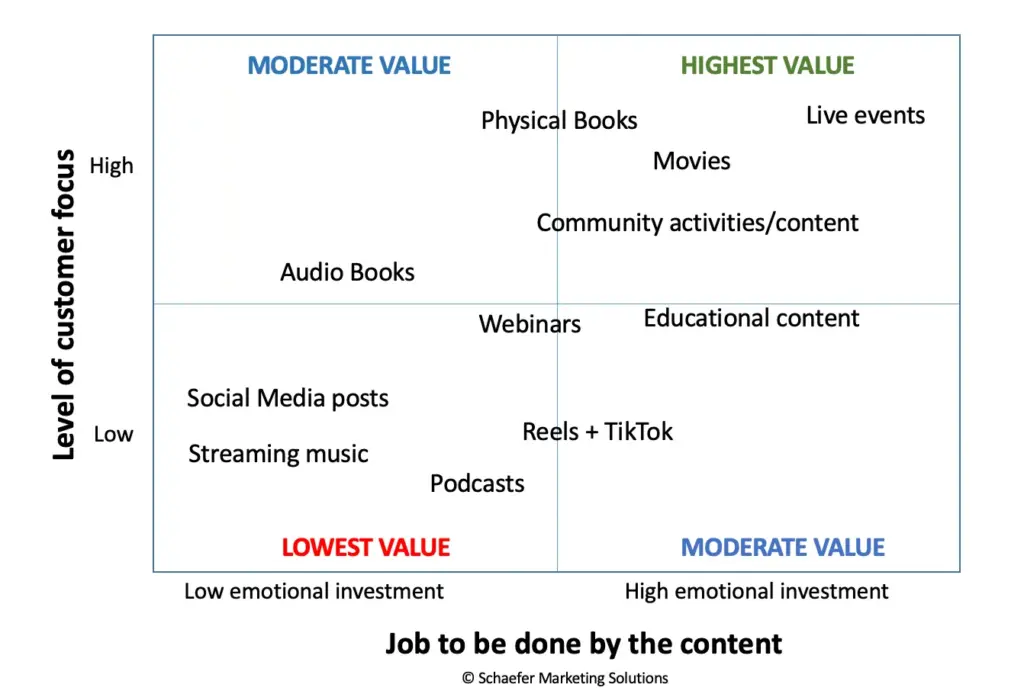
The attention quotient consists of two primary components: 1) consumers’ level of focus, or how actively they’re engaged with the content, and 2) the job to be done, or why they are consuming the content. Taken together, these components have significant predictive power on monetization.
Let’s look at these two factors — level of focus and the job to be done — more carefully to see how this might work in practice in our own companies.
Level of focus
McKinsey’s research revealed several insights about where and how consumer focus differs across media:
- In-person experiences elicit the highest level of focus.
- Books (digital and physical) engage audiences to a comparable degree with live experiences
- Console and PC gaming is the only digital medium that gets close to live levels of focus
- Community events create a high level of focus, even in digital, where group activities elicit higher focus than more solitary activities.
- Younger consumers aren’t less attentive; they just pay attention to different media. Gen Z consumers and baby boomers report the same average level of focus, but it’s split across different media: Gen Z consumers are highly focused when playing video games, while boomers prefer reading.
- Overall, the more focused consumers are, the more likely they are to spend. Across consumers, a 10 percent increase in average focus paid across media is associated with a 17 percent increase in consumer spending. Consumers in the top quartile of focus spend twice as much as those in the bottom quartile.
The job to be done
The second factor builds on a famous framework created by Clayton Christensen. When a person consumes your content, what are they “hiring it” for? What is the job to be done?
The primary “job to be done” of media consumption falls into one of five categories (from most to least valuable):
- To enjoy something that I love. In-person experiences—including live concerts and music festivals, theme parks, sporting events, and movie theaters—dominate this category. Physical books and (to a far lesser extent) audiobooks are also consumed primarily for love.
- For education and information. This is the primary job to be done for newspapers, magazines, and podcasts.
- For social connection. This is the primary job of social media sites (Facebook more so than others). Social video (including Instagram reels and TikTok but not YouTube), live events, and video games overindex on this role.
- For light entertainment and relaxation. This is the primary job of cable television, video streaming, social video, and mobile and console gaming.
- For background ambience. This is the primary role of radio, digital music, podcasts, and cable television.
Adding these two factors to our content analysis begins to shed light on why not all marketing-related content is created equal:

Implications for demographics
The research also allowed McKinsey to tease out three distinct customer groups based on their high level of economic value:
Content lovers
Entertainment omnivores represent 13 percent of all consumers. Curious and passionate, they spend 2.4 times more money on content and consume 1.7 times more content than the average consumer. They’re the superfans, casting their consumption nets wide to see the movie franchise, watch the spin-off show, ride the themed roller coaster, and buy the items advertised at every step.
Interactivity enthusiasts
The immersion seekers (16 percent). Competitive and lively, they love video games, sports, online betting, and comedy. They prefer endorsements to advertisements, overindex in user-generated content, and spend a reasonable amount of time on online message boards such as Reddit. Although eager consumers, they find the modern media landscape confusing, difficult to navigate, and overly expensive.
Community trendsetters
The culture creators (10 percent). Extroverted tastemakers, they seek out large communal events such as concerts, movies, and theme parks. They’re active on social media and drive online culture and fandom, often with outsize spending on their hobbies and interests. They enjoy advertisements more than any other segment, and when they’re not setting the cultural conversation, they’re shopping.
The report clusters the remaining 60 percent of consumers in groups with lower attention value, and thus lower economic value.
Implications for marketers
The competition for consumer attention has long been measured by audience size and time spent. This view misses the whole story (a point I made in my 2017 book, The Content Code).
It also reinforces the basic idea behind Content Shock: you’re probably going to have to pay more for the content types that cut through the noise.
The attention equation helps clarify what the winners in that competition have suspected: Quality and relevance, not just quantity, of attention go a long way in determining success. In a media environment defined by abundance, fragmentation, and distraction, marketers must ask themselves:
-
Is my content designed for high focus or low focus?
-
What job am I really being hired for?
-
How can I elevate the focus or shift the job?
Think about this practical example: Google wanted to shine a light on the Nobel Prize-winning work of its genius AI leader, Demis Hassabis.
Most companies might put out a press release or a blog post — very low attention value. But Google produced a full-length documentary called The Thinking Game. It already has 14 million views on YouTube alone.
According to the McKinsey formula, this film is already worth more than $100 million in attention. Let’s say it took $5 million to make the film. This would break most content marketing budgets, but within the McKinsey model, that is a bargain. And that return on attention that will only grow as the movie is viewed over time.
Implications for strategy
This research tells us something I’ve been circling around for years: the brands that win aren’t the ones who shout the loudest, but the ones who create moments that matter. Attention is no longer a game of volume. It’s not about hacking the algorithm or flooding the zone. It’s about earning focus and aligning with the deeper job your audience needs you to do in their lives.
That’s the frontier now. Not more content … but higher-quality attention.
The companies that embrace this shift will stop measuring the wrong things. They’ll stop obsessing about impressions and start designing for immersion. They’ll stop producing noise and view content as nourishment. And in a world overwhelmed by Content Shock, that will be the ultimate competitive advantage.
I also want to connect the dots between the Attention Equation and a post I wrote about ethically-sourced marketing. If we turn our focus to higher-value content, it could reduce the social media “litter” that drives up energy costs and funds online hate and bullying.
Make something worth hiring. Make something worth focusing on. Make something worthy of the precious, finite human attention that has become the most valuable currency in the world.


Follow Mark on Twitter, LinkedIn, YouTube, and Instagram
Illustration courtesy Nano Banana