


 You’re in marketing for one reason: Grow. Grow your company, reputation, customers, impact, profits. Grow yourself. This is a community that will help. It will stretch your mind, connect you to fascinating people, and provide some fun along the way. I am so glad you’re here. -Mark Schaefer
A few years ago. I had the famed author Tom Peters on my podcast. He was retiring and had written his last book.
Two years later, he was back on the show with another book!
“What happened?” I asked. “I thought you had retired!”
 “I’m still desperate to get my ideas out,” he said. “I don’t think enough people have heard me yet. In fact, I think the best authors and speakers have this quality — they’re desperate to get their ideas out into the world.”
And, I believe this is true and wise. I feel the same way. I am driven to publish because I’m desperate to get ideas into the world that can help people … and not enough people are listening.
The math works like this: A respectable open rate for a newsletter is about 20%. I am fortunate to have eager and loyal readers so my open rate is typically above 40%. But that means that 60% of the people who love me most, my subscribers, may miss what I had to say that week.
So I feel desperate to try again.
This post is different. It’s a reflection on the ideas I’ve repeated often, and yet I think most people haven’t heard me yet.
Like Tom Peters, I will probably keep trying until the end (whatever that might be). Here we go with some primary ideas. I’ve provided links in the posts for more information if you want to read more (please do).
1. Your personal brand is your last line of defense against AI
 I’ve been shouting this from the rooftops for years. In a world saturated with AI slop, the only messages that will rise above the noise carry meaning. You have to mean something to your audience.
Look, we’re in a tough world. AI might be nipping at the heels of your skill set or career. But if you’re KNOWN in your industry, more calls will be returned, more doors will open, more opportunities will come your way. Investing in your personal brand is like making deposits in an insurance policy for your career.
In any message, the “from” line is more important than the “subject” line.
Best resource: My book KNOWN, the world’s bestselling book on personal branding.
2. Give in to the bots.
 The introduction of AI as our friend / co-worker / companion / enemy heightens the emotion in our marketing discussions, but perhaps nothing has fanned the outrage more than the idea that AI only exists by stealing our content.
Protecting our content from AI has become a global obsession.
But our own businesses and careers face an existential crisis if we are NOT seen by the bots. We have to put our egos aside and recognize that yes, it hurts that Ai is stealing our content, but in the long-term, our businesses are in a better position if we are in the game.
Give it away, give it away, give it away now.
3. Universities need a dramatic and immediate overhaul
 I’ve taught at a university for 15 years and have lectured at dozens of colleges that use my books as texts. I care about these institutions, and they are in big, big trouble.
It gets down to this. Colleges are no longer the gatekeepers of knowledge. AI makes intelligence abundant and free. Colleges need to radically overhaul their systems, and in this post, I show how it is possible.
For most career options, it no longer makes sense to fork over so much money for four-year degrees that are becoming obsolete. Instead of the traditional four-year model, I proposed an affordable lifelong learning university subscription.
The university can still have a role in our future careers, but it must start an urgent transformation now.
4. Competence doesn’t cut it
 Over the past year or so I’ve had to dig deep to discern how humans will survive and thrive in world of AI content and marketing … if at all.
Many marketers and creators are perilously close to crossing The Milli Vanilli Line. They’re not enabled by AI. They’re using it to fake their presence, their careers, their influence.
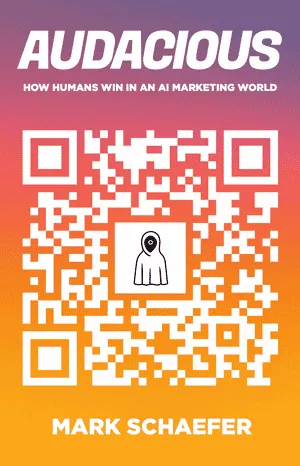
I went on a global journey to discover how the best creatives were rising above the noise in a way that was uniquely and sustainably human. The result is my book Audacious: How Humans Win in an AI Marketing World.
If you’re merely competent, you’re about to be replaced. The key idea is creating ideas that are truly disruptive. This is a book of hope filled with hundreds of ideas, inspiring case studies, and a framework for human effort to survive in the AI Era:
- Disrupt the story
- Disrupt where the story is told
- Disrupt who tells the story
5. It’s time for ethically-sourced marketing
 Every digital ad dollar we spend fuels algorithms we know are harming people, chewing up the environment, and stoking hate between neighbors.
It pains me to write about this. I mean, I’m part of the problem, too. But it’s time to start this conversation because the traditional marketing approach is at a breaking point.
- AI-driven amplification of addiction
- Deep fake, misinformation, the decline of trust
- Easy AI content requires more energy consumption
- U.S. Surgeon General’s warnings on youth mental health and social media
We can’t keep burying our heads in the sand. It’s time to consider what it means to lead and sponsor ethically-sourced marketing.
6. The False Hope of Content and SEO
 From Content Shock to the creator economy and SEO scams, I’ve tried to communicate realistic expectations for content marketing.
I’ve worked with dozens of diverse companies, and nearly always, they’re producing content because they’re afraid not to. Content marketing and a storytelling industrial complex seem to have taken on a life of their own.
Without a strategy and realistic, achievable goals, these random acts of content suck up time and contribute to an unwinnable content arms race. Breaks my heart to see this massive waste. And it’s getting worse in the AI Era.
There is a place for content and SEO. But marketing does not begin with TikTok videos, podcasts, and LinkedIn posts. It begins with strategy.
7. You’re not in control of the marketing message
 The overarching theme of my popular book Marketing Rebellion is that most marketers are asleep and not connected to real consumer realities. The foremost concern is thinking that your marketing team is in charge of your marketing message.
A brand used to be what we said it was. Now, it’s what other people say you are (online, in reviews, in posts from influencers).
This trend is simply accelerating as employees walk off the job when they disagree with commercial contracts, and organized rage farms decide to take down brands at will.
8. Community is the future of marketing.
 In 2018, I began predicting that brand communities would play a bigger role in mainstream marketing efforts. I dedicated an entire chapter to this idea in Marketing Rebellion and believed this was probably the most important chapter in the book.
Then the pandemic happened, and this idea accelerated as online communities became the primary form of human connection. People dropped me notes saying my predictions were coming true before our eyes.
I decided this was important enough to devote an entire book to the subject: Belonging to the Brand: Why Community is the Last Great Marketing Strategy.
A bold claim. Look around. I’m right. Dive in.
9. Momentum is a process
 A great deal of my consulting practice is devoted to people and companies that are stuck. You can’t count on luck to rise to the next level. You need momentum, and that can be managed.
There is a whole field of sociology dedicated to momentum, but it hasn’t really been applied to marketing before. I did that for the first time in a book called Cumulative Advantage … in hindsight, a terrible title, but a beloved book nevertheless.
Having an idea, career, or business stuck in the mud doesn’t have to be destiny. There is a process behind successful people.
10. Influencer Marketing is just beginning
 I suppose I was a pioneering voice in the area of influencer marketing, writing the first book on influencer marketing in 2012 — before anybody was even talking about it.
There has probably been no idea more battered, misunderstood, and left for dead.
But here’s what the pundits miss. An influencer isn’t just some kid hawking an energy drink. They are regarded as a trusted friend — a meaningful parasocial relationship.
And in a time filled with misinformation, polarization, and deep fakes, we will want to buy from trusted friends more than ever. Influencer marketing is jsut beginning.
11. Awe as marketing strategy
 Let’s connect a few dots. In the AI Era, we’ll long for human connection. We are already in a period of unprecedented isolation, loneliness, and depression.
Bringing people together for experiences isn’t just good business, it’s great brand-building.
Recently, I gave a speech in New York and people were cheering and laughing out loud. I asked them, “If you were watching this online at home, would you have the same, vocal reaction to my talk? No. They wouldn’t. The most I could hope for would probably be a muted chuckle here and there.
What’s the difference? When we bring people together, it creates an emotional contagion of awe called collective effervescence. These great feelings transfer to the brand.
What would it look like to have a marketing strategy of “add more awe?” You can read more about this in the Audacious book.
12. The Most Human Company Wins ™
 Perhaps my most durable argument, a theme that runs through every book, blog post, and speech — The Most Human Company Wins.
This is not a Pollyannaish “Go, Humans!” cheer, and I’m not anti-tech. I’m pro-humanity. I’m a realist. The paradox is that as automation rises, human connection becomes more valuable, not less.
By the way, going forward, the most human company isn’t necessarily all “human.” It will undoubtedly be a combination of AI trained on best practices and human connection.
Add your smile, your face, your personality. Add your story, your passion, your compassion at every customer touchpoint. The most human company wins.

So, those are a few ideas that burn in my heart every day. If you follow me, you’ll probably hear about them again because these ideas help people, and I’m desperate to get them out into the world.
Have you thought about the ideas and stories that you’re desperate to get into the world? Reflecting on that is a useful first step in building your own personal brand.
See? There I go again : )
 Need a keynote speaker? Mark Schaefer is the most trusted voice in marketing. Your conference guests will buzz about his insights long after your event! Mark is the author of some of the world’s bestselling marketing books, a college educator, and an advisor to many of the world’s largest brands. Contact Mark to have him bring a fun, meaningful, and memorable presentation to your company event or conference.
Illustrations a combination of prompts from Midjourney and Claude.